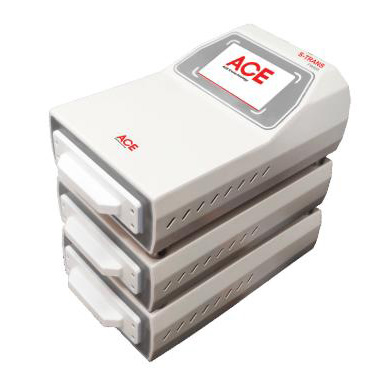
S-TRANS rapid multi-channel semi-dry transfer instrument
Electrical transfer printing is a commonly used technique in many research and diagnostic laboratories. The traditional wet transfer process for preparing reagents and the transfer process takes a considerable amount of time, usually more than one and a half hours.The S-TRANS rapid multi-channel semi-dry transfer instrument launched by ACE significantly reduces the protein transfer time while ensuring performance.With the S-TRANS rapid multi-channel semi-dry transfer instrument, the transfer time can be shortened to 5 minutes at the fastest. The accompanying transfer buffer provides high transfer efficiency and reproducibility.The S-TRANS transfer system consists of a main unit, a semi-dry transfer box, two-stage buffer solution and water-absorbing medium;If one main unit cannot meet the transfer requirements, up to two expansion auxiliary units can be connected to the main unit. The auxiliary units have the same transfer function as the main unit and do not need to provide additional power supply. Their power supply and operation are all provided by the main unit.When in operation, the main unit and the auxiliary unit can be placed in a stacked manner. The main unit is placed on top of the auxiliary unit, and there is a structure for fixation between the main unit and the auxiliary unit. If a second expansion auxiliary unit is used, this auxiliary unit can be placed at the bottom position.
The semi-dry transfer box can hold up to two Mini(7.0x8.5cm) gels at most.When transferring, place the assembled "sandwich" composite structure into the transfer box, close the box lid, insert the transfer instrument (for operation details, see 3.2), select or edit the appropriate transfer program to start the transfer (for operation details, see 3.4).The supporting transfer kit includes: S-TRANS anode buffer, S-TRANS cathode buffer, and S-TRANS high-efficiency transfer gasket (7.0x 9.5cm).
When using nitrocellulose membranes or PVDF membranes, the membranes need to be balanced in the anodic solution for more than 15 minutes. This step is usually carried out simultaneously during the electrophoresis process.The preset, modification and operation of the instrument's transfer program are simple and convenient, and multiple transfers can be carried out continuously.
1.1 Unboxing and Installation Instructions The S-TRANS system kit includes a main unit (which can be paired with a secondary unit). Besides the main unit, it is also equipped with a semi-dry transfer box (including the base and cover), a transfer roller, a standard power cord, a pair of tweezers, and two plastic boxes.The plastic boxes are respectively used to store S-TRANS anode buffer and S-TRANS cathode buffer to wet the S-TRANS high-efficiency transfer film gasket and transfer membranes.
In addition to the main body, the sub-unit is also equipped with a semi-dry transfer box (including the base and cover) and a standard connection cable to the main unit.When installing, place the instrument on a horizontal working surface with at least a 6 cm gap around it for ventilation. Insert the power cord into the back of the main unit and then connect it to a standard ground socket.If you need to connect the auxiliary unit, place the main unit on top of the auxiliary unit, unscrew the protective covers of the connection ports between the main unit and the auxiliary unit, and connect the main unit and the auxiliary unit with standard connection wires. Remove the protective foam of the instruments and equipment, and turn on the power switch at the back of the main unit to complete the installation.
NOTE: Do not place items on top of the S-TRANS system.
1.2 Chemical compatibility The S-TRANS system and transfer box assembly are incompatible with strong acids or bases,chlorinated hydrocarbons (such as chloroform), aromatic hydrocarbons (such as toluene, benzene), or acetone. The instrument casing and transfer box can be cleaned with water and mild detergent.Do not use abrasives or organic solvents for cleaning.The cathode stainless steel plate installed inside the box cover can be cleaned with 5% acetic acid and then wiped with water. 1.3 Safety Precautions When using the S-TRANS system instrument, the following guidelines should be observed and followed.The S-TRANS system instrument should operate under an ambient temperature of 15-31 °C and a relative humidity of 0-95%. It is not recommended to operate this instrument outside of this condition.
• To ensure sufficient air cooling, please make sure there is at least a 6 cm gap around the instrument and that the fan vents on both sides and at the back of the instrument are not blocked.
• Always connect the unit to a groundedAC socket using the power cord provided in the package.
• Be careful when removing the transfer box from the unit after the transfer is completed,as the transfer box may overheat.
• Do not operate under extreme humidity conditions (>95%),nor when condensation affects the internal circuits of the instrument.
• Operating the S-TRANS system at <15°C is not recommended.
• For your safety and to protect your S-TRANS system instruments,it is recommended that you clean the instruments regularly in accordance with the attached instructions.
• After the transfer is completed, it is recommended that you rinse the base and cover of the transfer box with deionized water to remove the residual buffer salt and prevent salt accumulation.Dry at room temperature or wipe the anode plate and cathode plate with a paper towel.
• Before using the instrument, do not place the buffer solution or the S-TRANS high-efficiency transfer film gasket with buffer solution in the transfer box. • Install and operate the instrument in a clean and dry location. During operation,keep the inside and around the instrument dry.
• This instrument is for laboratory use only.
| Product | Cat.No. |
|---|---|
| S-TRANS fast multi-channel semi-dry transfer printer (host) | FW606 |
| S-TRANS fast multi-channel semi-dry transfer printer (auxiliary machine I) | FW607 |
| S-TRANS fast multi-channel semi-dry transfer printer (auxiliary machine II) | FW608 |