For different sorting columns, the spacing between iron beads ranges from 250–500 μm, which is more than 10 times the diameter of white blood cells. This allows cells to flow freely without compression or adhesion. The column is filled with iron beads of specific specifications, amplifying the magnetic field by up to 10,000-fold. As a result, only a very small amount of “compact” magnetic beads is needed to achieve effective cell sorting. In contrast, non‑column sorting operates under an extremely low magnetic field, requiring either a large quantity of beads or micron‑sized “bulky” beads to compensate.
Using PBMCs from apheresis as the cell sample, cells were incubated with Miltenyi CD34 selection beads and sorted on a fully automated cell sorter using separation columns from Boyi and competitor M, respectively. Post-sorting, cells were subjected to cell counting, fluorescent antibody labeling, and FACS analysis. The purity and recovery of the sorted cells were very close to those obtained using the competitor's products.
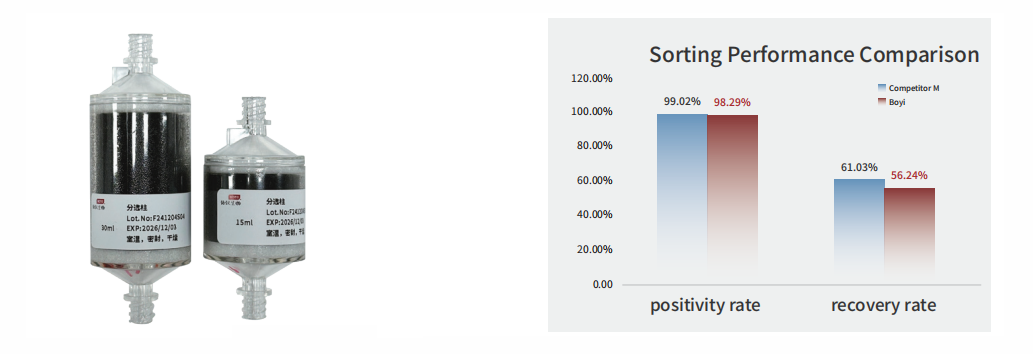
Columns (Left),Purity and recovery rate are comparable to those of competitor M (Right).